I was disappointed to find out today that Carrefour will only be charging less than 1 yuan (7 yuan makes up one U.S. dollar for now) for per a plastic bag to customers that don't bring their own. Unfortunately, I don't think this "financial burden" will convince anyone to make a concerted effort to bring cloth bags to the grocery stores.
This is somewhat similar to the situation in the U.S. with gas prices. It's only $4 a gallon gas that will convince someone to use public transportation, buy a more fuel efficient vehicle, and rethink their habits. (My husband, Josh, has been saying this for awhile and here's an excellent Thomas Friedman column on the topic, http://www.nytimes.com/2008/05/28/opinion/28friedman.html?em&ex=1212206400&en=6acc7e173e4e0dc8&ei=5087%0A.)
Some people need to lose green before they decide to go green. The consequences are immediate and personal. I guess, that's the incentive for change that works the best.
Thursday, May 29, 2008


Monday, May 26, 2008
The Highs/Lows of Expat Life
It's hard to believe that 6 months have past living in Shanghai. There have been "bad China days" (as many expats would say) and days where I'm amazed by what I've experienced in this rapidly developing country.
Here's a quick rundown of what I've seen so far:
Lows
-Censorship: Blocked Web sites have included..wikipedia, philly.com, some Taiwan sites, occasional Web links on the news Web sites such at the New York Times and CNN
-Polution: Can I look directly at the sun most days through the haze? Yes!
-Grocery shopping: A one hour grocery trip now takes about 3 hours or more. I need to check out 4 grocery stores to find the more Western items. Things that are hard to find at times include, sour cream, cream cheese, canned black beans, and chicken sausage. I cannot get red pepper flakes, buttermilk (I miss buttermilk pancakes!), cheese curds, or hot italian sausage.
-Mold: There isn't any installation in my apartment. Most new high rise apartments are built using concrete for their exterior walls. The warm heat inside and cool, humid air outside created the perfect conditions for mold to take over our walls this past winter. To make it worse, our property managment kept scaping off the mold off our damp walls and it kept coming back for 2 months. Mold isn't a health concern here so they didn't take us very seriously until...we got my husband's company involved to help us find a more permanent solution to the problem.
-Smoking: A nice relaxing brunch on Saturday or Sunday morning interupted with smoke being blown in your face. In general, many more people smoke here than in the U.S. They may not have a obesity problem, but they've got a smoking one.
-Spitting : This is no regular spitting. Before someone spits here, they make sure that they've completely cleared out their throat in the loudest way possible. People spit inside grocery stores, constantly into garbage cans everywhere, and out of cars onto the sidewalk without a second thought.
-Pushing: You can't leave any space in line or you'll risk someone getting in front of you. I've even had to throw an elbow here and there. With both the spitting and pushing, I constantly remind myself that this is the norm here.
-Food poisoning: Luckily, Josh and I haven't had serious food poisoning...yet. Josh had it the worst one time after eating food at a cafeteria. He had stomach cramps for several days and a fever for one day. I got the shivers and felt nausous for a day after eating at a microbrewery for lunch.
Enough complaining, I know. Overall, this has been a great experience and I look forward to the next couple of years. To counter the lows, here are my highlights:
Highs
-Navigating a new environment : It's always fascinating to walk the streets and observe daily life in the city.
-Learning a new language: I would consider this both a high and a low. I've quickly learned that picking up Mandarin will not be easy. Weekly lessons with a tutor have been fun and frustrating at times. I'll definitely keep practicing and taking the lessons though!
-Travel: I've really enjoyed trips in the region (Taiwan, Malaysia), within China (Qingdao, Guilin/Yangshuo) and near Shanghai (Hangzhou, Suzhou). It's gotten me more interested in photography with all the things that we've seen -- whether if it's kids having fun at the park, breathtaking landscapes, or capturing what I perceive to be funny poses by the Chinese for photos.
-Restaurants: While grocery shopping can be tough, there is no shortage of selection when it comes to restaurants. Some of my favorite places are Din Tai Feng for the best broth filled pork dumplings, and Paul, a French bakery with mouthwatering macaroons.
-Meeting fellow expats and local friends: We've met expats from the U.S., Australia, Europe, Brazil, etc. to join us in our exploring and they've continuously offered us support when we needed it. Our Chinese friends have helped us learn more about the culture and not to get ripped off when we go bargin.
-Shopping: There appears to be an endless amount of stores here. I'll just say you can find all sorts of boutiques and department stores. Getting custom made clothes at reasonable prices is a plus, too. Josh can't get enough of his fitted dress shirts.
Most striking
-The abundance of labor: I've never seen so many people working in hotels, restaurants, and retail stores. No excuse for bad service! (I think the excess of labor keeps some processes from becoming more efficient, but that's a whole other subject for another post.)
-The rapidly changing landscape: Neighborhoods disappear and high rises seem to go up at a constant pace.
-The gap between the poor and the more affluent: Many people here in the city still live in terrible conditions with luxury hotels/highrises just next door.
Unexpected
-People freely going through your items at IKEA or at the grocery store. If you're not looking, they may even take something out. Be watchful!
-Chinese people don't exercise the same way people do in the U.S. Parks are filled with people strolling around with some women in uncomfortable high heels. There are hardly any runners. I've even seen women wear high heels on a hike before.
Well...this is a brief glipse into my life here at this point. It'll be interesting to see how my perspective changes in time. I look forward to learning more of the language to increase my freelance opportunties with local publications and to send stories back to the U.S.
Going Green in Shanghai
More than ever, it's become important to spread "green" messages in China. As the economy continues to develop, people need to know that they can play a role on the individual level to fight the effects of global warming.
After moving here, I was shocked to find that a formal recycling program doesn't exist. Right now, people will go through the garbage to look for items like plastic bottles to take to recycling centers. The government is beginning to take some action by banning filmsy plastic bags in grocery stores. People will now have to pay if they want to use the bags. It's the hope that people will go back to using cloth bags and baskets like they did 20 years ago.
The following article will appear in the June issue of The Courier, the magazine of the Shanghai Expatriate Association. Before writing the story, I thought that I was doing a pretty good job with being green - bringing cloth bags to the grocery store, taking shorter showers, and turning off lights when I left a room. But I quickly found out that there is so much more than I could be doing after doing interviews with these environmental groups and firms. I've decided my next efforts to be more green will involve using more public transportation and buying more local foods. I just started to unplug all my appliances at the wall if I'm not using them.
Here's my story:
In Shanghai, it’s easy to see the environmental consequences of rapid economic development with the hazy skies and murky waters.
Grappling with these issues throughout the country, the Chinese government has ordered the ban of free ultra-thin plastic bags common at shops and supermarkets starting in June. Customers will need to pay for any that they use. People go through up to 3 billion plastic shopping bags a day in China.
The government has also called for the return of cloth bags and shopping baskets that residents used before the filmsy plastic bags became widely available. While it’s an important initiative, Shanghai firms, organizations, and environmental advocates say that more can be done at the individual level.
This city wide green effort kicked off in April at the Eco Design Fair at the Urbn Hotel, the country’s first carbon neutral hotel. The fair featured products from over 25 eco-conscious businesses and groups, including organic clothing, home accessories, toys, building materials. A portion of the proceeds were donated to Shanghai Roots & Shoots and its tree planting program in Inner Mongolia.
“Green living is a consciousness of lifestyle…understanding how our lifestyles impact our surrounding environments,” said Ryan Dick, A00 Architecture. The firm encourages clients to incorporate green elements into their projects.
A00 Architecture along with SGTH Design, Wobabybasics, and the Urbn Hotel recently formed Green Ideas Green Action (GIGA) to share the best practices for sustainability in the design community. The group has started a database of local sources of green materials and textiles on its Web site.
GIGA holds events for the design community, but we will also plan events for the general public to share ideas on how to be more green, Dick said.
Dick said tracking an energy bill can help someone start reducing their energy consumption. Some simple steps that can be taken in home include turning up the thermostat a few degrees during the summer and unplugging appliance from the wall.
“It starts creating an awareness. Once you start actively paying attention, it makes you enthused to do more,” he said.
The challenge ahead cited by groups like GIGA is creating a consciousness about environmental issues and the individual’s influence on a daily basis.
“A lot of people want to do something, but they think, ‘Can an individual make a difference? It’s up to the corporations and government.’ With 1.3 billion people, everyone can make a difference” said Jessica Sun, who founded Shanghai Live Green Eco-Tech Inc last year. The company spearheads educational programming and produces eco-friendly products such as bags made out of recylcled plastic bottles and portable stainless steel chopsticks.
“In the old days, we would reuse, but now people want the convenience. We tell people it’s a lifestyle [to be green], it’s not just going back to the old times,” added Sun, a native Shanghaiese, who returned to the city in 2006 after living in Canada for a decade.
“The economic development is good, but it’s the cause of the environmental impact. Climate change is the threat that we’re facing,” she said.
Sun and her group currently works with the local municipal governement and universities. They’ve held “no plastic bag days” at area supermarkets and forums for the students to watch the American documentary, An Inconvenient Truth.
Shanghai firms have also taken education to rural areas. Environmental consultants from Greennovate started the Greennovate Environmental Challenge for Kids Outreach (GECKO) after working with businesses in these areas.
We designed 6 modules that give an introduction into how the environment works and how people impact it. The program takes place over the course of several months. Currently, 1,000 students from two high schools and one middle school in Guizhou Province are participating, said Mihela Hladin, general manager of Greenovate.
“If we teach a message with them, they can reach the entire family. We are showing them that they can do something small and it counts,” Hladin said.
In Moganshan, a thickly forested hilltop area about 60 km north of Hangzhou and 200km away from Shanghai, Naked Retreats offers guests a more green place to stay. The retreat rennovated and operates its houses in an environmentally friendly manner, promotes environmental awareness through education, and provides employment opportunities in the immediate area to residents.
“It’s part of our internal philosophy…More than tips, we’re sharing an attitude about our earth,” said Gabriela Lo, managing director of Naked Retreats.
The retreat doesn’t market itself as eco-friendly, but many of guests find out how we operate, Lo said.
In a city of 18 million, environmental advocates remain optimistic that changes will take place over time. With the World Expo in 2010, the city is expected to go green where it can in the planning of the festivities.
The eco-conscious group is growing among the Shanghaiese and there are more expats coming to live here, Sun said. “Expats are trendsetters to Chinese people. The Chinese people think what the foreigners do is fashionable,” she said.
Hladin said students in the rural communities have taken a strong interest in their efforts in reaching out to them.
“I think the foreign community is at a high level of awareness. This is a good first step,” said Hladin. “NGOs are also running more programs. It shows big interest that this is the way to go.”
Boxes accompanying the story:
What is a carbon footprint?
A carbon footprint is a measure in units of carbon dioxide that calculates the impact of human activities to global warming. Some of these activities include lighting and electricity, heating and cooling of the home, transport, travel, and the purchasing of goods. Calculate your footprint at www.carbonfootprint.com. Living a greener lifestyle can help reduce your footprint.
Everyday Tips for Being Green:
-Unplug your appliances/electronics at the wall
Appliances on “stand by” look like they are switched off, but they still drawing a significant amount of power - and costing you money. You can turn off your computer at the end of each day.
-Bring your own bags for shopping
Jooi Design and Greennovate have collaborated on a reusable Bag that is functional and compactable that you can carry with you everywhere. Proceeds from the sale of the bag will go to Greenovate’s efforts to educate children in rural China about the environment. Bags available at the Jooi Design Studio, International Artist Factory - Taikang Lu, Lane 210, Studio 201, www.jooi.com. Shanghai Live Green Eco-Tech sells a bag made out of recycled plastic bottles, www.livegreen.com.cn.
- Wash your clothes in cold or warm water instead of hot
Using warn or cold water saves 500 pounds of carbon dioxide a year, according to climatecrisis.net. Drying your clothes on a clothesline six months out of the year would save another 700 pounds.
-Pay for your carbon emissions
You can help offset the carbon footprint of your car, home and air travel by funding renewable energy projects through Shanghai Roots & Shoots’ Carbon Footprint Planting program (www.jgi-shanghai.org). Buy a tree for 25 rmb or a well for 8,000 rmb.
-Buy locally produced goods and food
Being in China, buying local goods isn’t a problem, but cutting down on buying imported goods can help.
-Use public transportation, bike, or walk when you can
-Turn off the lights when you leave the room
-Buy a reusable plastic water bottle
-Take shorter showers
For more information and tips:
-Greenspace, www.greenspace.cn/en/index.html, go there to download "The Environmentally Friendly Gardener"
-Greenovate, www.greennovate.net/
-The Daily Green, www.thedailygreen.com
-Green Ideas Green Action (GIGA) www.giga-china.com
-Eco Design Fair. www.ecodesignfair.org The fair was in April, but the site features a directory of companies and individuals that offer environmentally friendly products and services.
-Naked Retreats www.nakedretreats.cn
-Live Green Eco www.livegreen.com.cn
Thursday, March 27, 2008
Taipei: A vibrant city with friendly people
The following is my first stab at travel writing. A version similar to this will appear in the April issue of the Courier, the magazine of the Shanghai Expatriate Association. I tagged along with Josh to Taipei when he had a business trip there earlier this year. I explored the city on my own for a couple of days. Lots of walking through a variety of different neighborhoods. with locals willing to help when I couldn't find my destination. Then Josh and I headed up to the northern coast to do some hiking and relaxing in the hotsprings. We ended the trip back in the city with an evening stroll through some of its busiest parts.
 The skyscraper is designed after the shape of bamboo, which represents fast growth and flexibility in Asian cultures. It’s also divided into 8 sections, 8 being a number associated with prosperity in Chinese culture. Attached to Taipei 101 is a high end shopping mall with cafes and one of city’s largest English book stores. It takes about 15 minutes to walk to Taipei 101 from the Taipei City Hall MRT Station. The ticketing booth and entrance are located at the 5th Floor of the Taipei 101 shopping mall. (No. 7 Hsinyi Road Section 5; Hours: 10 a.m. to 10 pm daily; Admission: 400 Taiwan dollars adults, 370 children).
To the sea
 One of the most popular destinations is the Fisherman’s Wharf walking area, a 15 minute bus ride on Red 26 from the station will get you there. Near the boardwalk is the Lover’s bridge, a single slanted white tower cable stay pedestrian bridge made to look like a sailing ship's mast and rigging. The boardwalk is lined with cafes, ice cream stands, and small restaurants with the city’s local foods.
 One of the most intriguing sites on the coast is Yeliou Geopark, located at Wanli. Yeliou is along an 1,700 meter long cape formed by the Datun Mountains reaching into the sea. The limestone layer on the seashore has been subject to erosion, weathering and earth movements, creating unique seawater eroded holes and rocks in the shapes of mushrooms, candle wicks, ginger, and spheres. A climb up to the observation deck gives you a view of the rock structures beneath the crystal clear blue ocean waters.
In general, the people in Taipei felt more at ease than the Shanghaiese. There really wasn't any pushing in the subways or cutting in line. Taipei at 2.5 million is a small fraction of the size of Shanghai, which could explain the more laid back atmosphere. But the explanation most likely points to the fact that its people progressed in the absense of the the cultural revolution and communist rule.
Anyway, here's the story...
While Taipei isn’t usually considered a tourist destination, a recent visit revealed a vibrant city of 2.5 million teeming with fascinating cultural sites.
The city can look over run by industry in some parts, but you’ll quickly be won over by its upbeat energy in its neighborhoods. The capital of Taiwan is known for its friendly people and safe streets.
Taipei’s location in between lush mountains makes it a place where you can get it all in one vacation. Learn more about a culture dating back thousands of years, experience nightlife in the clubs or lively street markets, or discover the city’s new modern upscale avenues. Less than an hour away, there’s hiking in lush thick forests and the opportunity to relax in soothing hot springs.
The extensive Mass Rapid Transit System or MRT (http://english.trtc.com.tw/) is the best way to get around. The MRT is cheap, easy to use, and clean. Make sure to pick up a “Taipei City Travel” from a Taipei Metro information desk, which outlines sites along each of its stops. Trains typically run from 6 a.m. to midnight.
City Trek
On your first visit, a trip to the top of Taipei 101 skyscraper at 508 meters will give you an expansive view of the city and its surroundings. The building – one of the tallest in the world – stands out amongst the mostly low lying structures in the city.
 The skyscraper is designed after the shape of bamboo, which represents fast growth and flexibility in Asian cultures. It’s also divided into 8 sections, 8 being a number associated with prosperity in Chinese culture. Attached to Taipei 101 is a high end shopping mall with cafes and one of city’s largest English book stores. It takes about 15 minutes to walk to Taipei 101 from the Taipei City Hall MRT Station. The ticketing booth and entrance are located at the 5th Floor of the Taipei 101 shopping mall. (No. 7 Hsinyi Road Section 5; Hours: 10 a.m. to 10 pm daily; Admission: 400 Taiwan dollars adults, 370 children).
Another essential place to go to is the National Palace Museum. It boasts one of the largest collections of Chinese artifacts and artwork in the world. The museum reopened in 2006 after an extensive four year renovation project. It features artifacts such as bronze, glass, and traditional paintings in well laid out exhibits with Mandarin and English descriptions. From the Jiantan MRT Station, the Red 30, 304 bus goes to the museum. (221 Chih-shan Rd., Sec. 2; Hours: 9 a.m. to 5 p.m. daily, extended evening hours: every Saturday, 5:00 to 8:30 PM (during extended evening hours, free admission); Admission: 160 Taiwan dollars)
A stop at the Longshan Temple gives you a look into how the Taiwanese take a break from hectic city life. As you enter, the posts and beams of the temple have intricate carvings along side the multiple statutes of gods inside. Those coming to seek guidance fill long tables with a variety of offerings including fruit, flowers and potato chips. Street food vendors offer local foods and shops sell various goods outside the Temple. The temple has its own Longshan Temple MRT stop.
Two exciting neighborhoods that capture the more youthful part of the city are near National Taiwan University (nearest MRT station, Gongguan) and Ximending Circle (Ximen MRT Station). You can find cafes, bars, trendy boutiques, and book stores in both areas. The National Taiwan University streets tend to be quieter with its students and scholars.
For an early evening stroll, the Ximending Circle area sometimes has live rock bands playing outside near Zhongshan Hall. Nearby local artists displayed their funky artwork and jewelry for sale. You can also sit down for a drink and people watch at a row of bars with outdoor seating in a large courtyard near Zhongshan Hall or a restaurant in the pedestrian zone.
By sundown, the Shilin Market turns into one of busiest areas in town. Locals and tourists patiently walk in single file lines to peruse goods and grab a tasty late night snack. The market – the largest in the city - has one street that stretches down to the north with items such as t-shirts, the latest fashions, and shoes. Next to this is an indoor food court where you can find crème filled pastries, noodles, ice cream, stinky tofu, and oyster omelets. The market is conveniently located outside the Jiantan MRT Station.
To the sea
If you’re looking for a day trip, Danshui is a small historical port city located northwest of Taipei. It was the center of commerce in northern Taiwan during the 19th century. The Danshui MRT station is about a 45 minute ride from the Taipei Main Station. Once arriving at the station, clearly marked buses can take you to city’s parks, museums and historic sites. A street market with local foods and cheap shoes and clothes is tucked behind the main thoroughfare, which is five minute walk from the station into the town.
 One of the most popular destinations is the Fisherman’s Wharf walking area, a 15 minute bus ride on Red 26 from the station will get you there. Near the boardwalk is the Lover’s bridge, a single slanted white tower cable stay pedestrian bridge made to look like a sailing ship's mast and rigging. The boardwalk is lined with cafes, ice cream stands, and small restaurants with the city’s local foods.
Northern Coast
A trip to Taipei isn’t complete without a visit north to its relaxing hot springs, which range from basic public baths to luxurious private resorts that offer spectacular views of the countryside. The three areas for hot springs are: Beitou, Yangminshan and Wulai. Wulai is located south of the city, while the other two are to the north.
A trip to Yangmingshan hot springs will also bring you into the lush forests of Yangmingshan National Park with its scenic hiking trails. Yangmingshan National Park can be reached by taking bus Red 5 from the Jiantan MRT station.
 One of the most intriguing sites on the coast is Yeliou Geopark, located at Wanli. Yeliou is along an 1,700 meter long cape formed by the Datun Mountains reaching into the sea. The limestone layer on the seashore has been subject to erosion, weathering and earth movements, creating unique seawater eroded holes and rocks in the shapes of mushrooms, candle wicks, ginger, and spheres. A climb up to the observation deck gives you a view of the rock structures beneath the crystal clear blue ocean waters.
This quick guide is only a small glimpse into what Taipei has to offer. The city has numerous cultural sites and monuments that offer insights into the island’s history. Parks are scattered throughout the city. Traveling further south is also worth a trip. Eastern Taiwan, cut off from the rest of the island by mountains, contains Taiwan's most striking natural scenery. The country’s second largest city, Kaohsiung, and oldest city, Tainan, are located in the south of the island. The south is more tropical than the rest of the island.
For more information on Taipei and Taiwan:
For more information on Taipei and Taiwan:
www.lonelyplanet.com/worldguide/taiwan/
http://wikitravel.org/en/Taipei
http://wikitravel.org/en/Taiwan
http://wikitravel.org/en/Taipei
http://wikitravel.org/en/Taiwan
http://travel.nytimes.com/2008/03/02/travel/02hours.html?pagewanted=1&ei=5070&em&en=5ce198d0ec93319e&ex=1204606800
For more information on hot spring resorts/spas:
For more information on hot spring resorts/spas:
Monday, January 28, 2008
A little snow, a lot of problems...
 It's been snowing here since last Saturday. It's the longest snowy stretch in 17 years. Accumulation reached almost 2 inches as of Tuesday, the most since 1984, according to the Shanghai Meteorological Bureau. The thick, slushy mess has caused roofs of old homes to collapse, halted trains and closed roads throughout the country. Read more at: http://edition.cnn.com/2008/WORLD/asiapcf/01/29/china.weather.apology/index.html?iref=mpstoryview#cnnSTCText
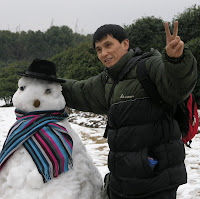
Amidst the serious problems, some have been able to relish this rare opportunity to enjoy it. You'd think this snowman in Century Park was a star. People lined up to take pictures with it in various poses.

Subscribe to:
Posts (Atom)
