More than ever, it's become important to spread "green" messages in China. As the economy continues to develop, people need to know that they can play a role on the individual level to fight the effects of global warming.
After moving here, I was shocked to find that a formal recycling program doesn't exist. Right now, people will go through the garbage to look for items like plastic bottles to take to recycling centers. The government is beginning to take some action by banning filmsy plastic bags in grocery stores. People will now have to pay if they want to use the bags. It's the hope that people will go back to using cloth bags and baskets like they did 20 years ago.
The following article will appear in the June issue of The Courier, the magazine of the Shanghai Expatriate Association. Before writing the story, I thought that I was doing a pretty good job with being green - bringing cloth bags to the grocery store, taking shorter showers, and turning off lights when I left a room. But I quickly found out that there is so much more than I could be doing after doing interviews with these environmental groups and firms. I've decided my next efforts to be more green will involve using more public transportation and buying more local foods. I just started to unplug all my appliances at the wall if I'm not using them.
Here's my story:
In Shanghai, it’s easy to see the environmental consequences of rapid economic development with the hazy skies and murky waters.
Grappling with these issues throughout the country, the Chinese government has ordered the ban of free ultra-thin plastic bags common at shops and supermarkets starting in June. Customers will need to pay for any that they use. People go through up to 3 billion plastic shopping bags a day in China.
The government has also called for the return of cloth bags and shopping baskets that residents used before the filmsy plastic bags became widely available. While it’s an important initiative, Shanghai firms, organizations, and environmental advocates say that more can be done at the individual level.
This city wide green effort kicked off in April at the Eco Design Fair at the Urbn Hotel, the country’s first carbon neutral hotel. The fair featured products from over 25 eco-conscious businesses and groups, including organic clothing, home accessories, toys, building materials. A portion of the proceeds were donated to Shanghai Roots & Shoots and its tree planting program in Inner Mongolia.
“Green living is a consciousness of lifestyle…understanding how our lifestyles impact our surrounding environments,” said Ryan Dick, A00 Architecture. The firm encourages clients to incorporate green elements into their projects.
A00 Architecture along with SGTH Design, Wobabybasics, and the Urbn Hotel recently formed Green Ideas Green Action (GIGA) to share the best practices for sustainability in the design community. The group has started a database of local sources of green materials and textiles on its Web site.
GIGA holds events for the design community, but we will also plan events for the general public to share ideas on how to be more green, Dick said.
Dick said tracking an energy bill can help someone start reducing their energy consumption. Some simple steps that can be taken in home include turning up the thermostat a few degrees during the summer and unplugging appliance from the wall.
“It starts creating an awareness. Once you start actively paying attention, it makes you enthused to do more,” he said.
The challenge ahead cited by groups like GIGA is creating a consciousness about environmental issues and the individual’s influence on a daily basis.
“A lot of people want to do something, but they think, ‘Can an individual make a difference? It’s up to the corporations and government.’ With 1.3 billion people, everyone can make a difference” said Jessica Sun, who founded Shanghai Live Green Eco-Tech Inc last year. The company spearheads educational programming and produces eco-friendly products such as bags made out of recylcled plastic bottles and portable stainless steel chopsticks.
“In the old days, we would reuse, but now people want the convenience. We tell people it’s a lifestyle [to be green], it’s not just going back to the old times,” added Sun, a native Shanghaiese, who returned to the city in 2006 after living in Canada for a decade.
“The economic development is good, but it’s the cause of the environmental impact. Climate change is the threat that we’re facing,” she said.
Sun and her group currently works with the local municipal governement and universities. They’ve held “no plastic bag days” at area supermarkets and forums for the students to watch the American documentary, An Inconvenient Truth.
Shanghai firms have also taken education to rural areas. Environmental consultants from Greennovate started the Greennovate Environmental Challenge for Kids Outreach (GECKO) after working with businesses in these areas.
We designed 6 modules that give an introduction into how the environment works and how people impact it. The program takes place over the course of several months. Currently, 1,000 students from two high schools and one middle school in Guizhou Province are participating, said Mihela Hladin, general manager of Greenovate.
“If we teach a message with them, they can reach the entire family. We are showing them that they can do something small and it counts,” Hladin said.
In Moganshan, a thickly forested hilltop area about 60 km north of Hangzhou and 200km away from Shanghai, Naked Retreats offers guests a more green place to stay. The retreat rennovated and operates its houses in an environmentally friendly manner, promotes environmental awareness through education, and provides employment opportunities in the immediate area to residents.
“It’s part of our internal philosophy…More than tips, we’re sharing an attitude about our earth,” said Gabriela Lo, managing director of Naked Retreats.
The retreat doesn’t market itself as eco-friendly, but many of guests find out how we operate, Lo said.
In a city of 18 million, environmental advocates remain optimistic that changes will take place over time. With the World Expo in 2010, the city is expected to go green where it can in the planning of the festivities.
The eco-conscious group is growing among the Shanghaiese and there are more expats coming to live here, Sun said. “Expats are trendsetters to Chinese people. The Chinese people think what the foreigners do is fashionable,” she said.
Hladin said students in the rural communities have taken a strong interest in their efforts in reaching out to them.
“I think the foreign community is at a high level of awareness. This is a good first step,” said Hladin. “NGOs are also running more programs. It shows big interest that this is the way to go.”
Boxes accompanying the story:
What is a carbon footprint?
A carbon footprint is a measure in units of carbon dioxide that calculates the impact of human activities to global warming. Some of these activities include lighting and electricity, heating and cooling of the home, transport, travel, and the purchasing of goods. Calculate your footprint at www.carbonfootprint.com. Living a greener lifestyle can help reduce your footprint.
Everyday Tips for Being Green:
-Unplug your appliances/electronics at the wall
Appliances on “stand by” look like they are switched off, but they still drawing a significant amount of power - and costing you money. You can turn off your computer at the end of each day.
-Bring your own bags for shopping
Jooi Design and Greennovate have collaborated on a reusable Bag that is functional and compactable that you can carry with you everywhere. Proceeds from the sale of the bag will go to Greenovate’s efforts to educate children in rural China about the environment. Bags available at the Jooi Design Studio, International Artist Factory - Taikang Lu, Lane 210, Studio 201, www.jooi.com. Shanghai Live Green Eco-Tech sells a bag made out of recycled plastic bottles, www.livegreen.com.cn.
- Wash your clothes in cold or warm water instead of hot
Using warn or cold water saves 500 pounds of carbon dioxide a year, according to climatecrisis.net. Drying your clothes on a clothesline six months out of the year would save another 700 pounds.
-Pay for your carbon emissions
You can help offset the carbon footprint of your car, home and air travel by funding renewable energy projects through Shanghai Roots & Shoots’ Carbon Footprint Planting program (www.jgi-shanghai.org). Buy a tree for 25 rmb or a well for 8,000 rmb.
-Buy locally produced goods and food
Being in China, buying local goods isn’t a problem, but cutting down on buying imported goods can help.
-Use public transportation, bike, or walk when you can
-Turn off the lights when you leave the room
-Buy a reusable plastic water bottle
-Take shorter showers
For more information and tips:
-Greenspace, www.greenspace.cn/en/index.html, go there to download "The Environmentally Friendly Gardener"
-Greenovate, www.greennovate.net/
-The Daily Green, www.thedailygreen.com
-Green Ideas Green Action (GIGA) www.giga-china.com
-Eco Design Fair. www.ecodesignfair.org The fair was in April, but the site features a directory of companies and individuals that offer environmentally friendly products and services.
-Naked Retreats www.nakedretreats.cn
-Live Green Eco www.livegreen.com.cn
Monday, May 26, 2008


Thursday, March 27, 2008
Taipei: A vibrant city with friendly people
The following is my first stab at travel writing. A version similar to this will appear in the April issue of the Courier, the magazine of the Shanghai Expatriate Association. I tagged along with Josh to Taipei when he had a business trip there earlier this year. I explored the city on my own for a couple of days. Lots of walking through a variety of different neighborhoods. with locals willing to help when I couldn't find my destination. Then Josh and I headed up to the northern coast to do some hiking and relaxing in the hotsprings. We ended the trip back in the city with an evening stroll through some of its busiest parts.
 The skyscraper is designed after the shape of bamboo, which represents fast growth and flexibility in Asian cultures. It’s also divided into 8 sections, 8 being a number associated with prosperity in Chinese culture. Attached to Taipei 101 is a high end shopping mall with cafes and one of city’s largest English book stores. It takes about 15 minutes to walk to Taipei 101 from the Taipei City Hall MRT Station. The ticketing booth and entrance are located at the 5th Floor of the Taipei 101 shopping mall. (No. 7 Hsinyi Road Section 5; Hours: 10 a.m. to 10 pm daily; Admission: 400 Taiwan dollars adults, 370 children).
To the sea
 One of the most popular destinations is the Fisherman’s Wharf walking area, a 15 minute bus ride on Red 26 from the station will get you there. Near the boardwalk is the Lover’s bridge, a single slanted white tower cable stay pedestrian bridge made to look like a sailing ship's mast and rigging. The boardwalk is lined with cafes, ice cream stands, and small restaurants with the city’s local foods.
 One of the most intriguing sites on the coast is Yeliou Geopark, located at Wanli. Yeliou is along an 1,700 meter long cape formed by the Datun Mountains reaching into the sea. The limestone layer on the seashore has been subject to erosion, weathering and earth movements, creating unique seawater eroded holes and rocks in the shapes of mushrooms, candle wicks, ginger, and spheres. A climb up to the observation deck gives you a view of the rock structures beneath the crystal clear blue ocean waters.
In general, the people in Taipei felt more at ease than the Shanghaiese. There really wasn't any pushing in the subways or cutting in line. Taipei at 2.5 million is a small fraction of the size of Shanghai, which could explain the more laid back atmosphere. But the explanation most likely points to the fact that its people progressed in the absense of the the cultural revolution and communist rule.
Anyway, here's the story...
While Taipei isn’t usually considered a tourist destination, a recent visit revealed a vibrant city of 2.5 million teeming with fascinating cultural sites.
The city can look over run by industry in some parts, but you’ll quickly be won over by its upbeat energy in its neighborhoods. The capital of Taiwan is known for its friendly people and safe streets.
Taipei’s location in between lush mountains makes it a place where you can get it all in one vacation. Learn more about a culture dating back thousands of years, experience nightlife in the clubs or lively street markets, or discover the city’s new modern upscale avenues. Less than an hour away, there’s hiking in lush thick forests and the opportunity to relax in soothing hot springs.
The extensive Mass Rapid Transit System or MRT (http://english.trtc.com.tw/) is the best way to get around. The MRT is cheap, easy to use, and clean. Make sure to pick up a “Taipei City Travel” from a Taipei Metro information desk, which outlines sites along each of its stops. Trains typically run from 6 a.m. to midnight.
City Trek
The city can look over run by industry in some parts, but you’ll quickly be won over by its upbeat energy in its neighborhoods. The capital of Taiwan is known for its friendly people and safe streets.
Taipei’s location in between lush mountains makes it a place where you can get it all in one vacation. Learn more about a culture dating back thousands of years, experience nightlife in the clubs or lively street markets, or discover the city’s new modern upscale avenues. Less than an hour away, there’s hiking in lush thick forests and the opportunity to relax in soothing hot springs.
The extensive Mass Rapid Transit System or MRT (http://english.trtc.com.tw/) is the best way to get around. The MRT is cheap, easy to use, and clean. Make sure to pick up a “Taipei City Travel” from a Taipei Metro information desk, which outlines sites along each of its stops. Trains typically run from 6 a.m. to midnight.
City Trek
On your first visit, a trip to the top of Taipei 101 skyscraper at 508 meters will give you an expansive view of the city and its surroundings. The building – one of the tallest in the world – stands out amongst the mostly low lying structures in the city.
 The skyscraper is designed after the shape of bamboo, which represents fast growth and flexibility in Asian cultures. It’s also divided into 8 sections, 8 being a number associated with prosperity in Chinese culture. Attached to Taipei 101 is a high end shopping mall with cafes and one of city’s largest English book stores. It takes about 15 minutes to walk to Taipei 101 from the Taipei City Hall MRT Station. The ticketing booth and entrance are located at the 5th Floor of the Taipei 101 shopping mall. (No. 7 Hsinyi Road Section 5; Hours: 10 a.m. to 10 pm daily; Admission: 400 Taiwan dollars adults, 370 children).
Another essential place to go to is the National Palace Museum. It boasts one of the largest collections of Chinese artifacts and artwork in the world. The museum reopened in 2006 after an extensive four year renovation project. It features artifacts such as bronze, glass, and traditional paintings in well laid out exhibits with Mandarin and English descriptions. From the Jiantan MRT Station, the Red 30, 304 bus goes to the museum. (221 Chih-shan Rd., Sec. 2; Hours: 9 a.m. to 5 p.m. daily, extended evening hours: every Saturday, 5:00 to 8:30 PM (during extended evening hours, free admission); Admission: 160 Taiwan dollars)
A stop at the Longshan Temple gives you a look into how the Taiwanese take a break from hectic city life. As you enter, the posts and beams of the temple have intricate carvings along side the multiple statutes of gods inside. Those coming to seek guidance fill long tables with a variety of offerings including fruit, flowers and potato chips. Street food vendors offer local foods and shops sell various goods outside the Temple. The temple has its own Longshan Temple MRT stop.
Two exciting neighborhoods that capture the more youthful part of the city are near National Taiwan University (nearest MRT station, Gongguan) and Ximending Circle (Ximen MRT Station). You can find cafes, bars, trendy boutiques, and book stores in both areas. The National Taiwan University streets tend to be quieter with its students and scholars.
For an early evening stroll, the Ximending Circle area sometimes has live rock bands playing outside near Zhongshan Hall. Nearby local artists displayed their funky artwork and jewelry for sale. You can also sit down for a drink and people watch at a row of bars with outdoor seating in a large courtyard near Zhongshan Hall or a restaurant in the pedestrian zone.
By sundown, the Shilin Market turns into one of busiest areas in town. Locals and tourists patiently walk in single file lines to peruse goods and grab a tasty late night snack. The market – the largest in the city - has one street that stretches down to the north with items such as t-shirts, the latest fashions, and shoes. Next to this is an indoor food court where you can find crème filled pastries, noodles, ice cream, stinky tofu, and oyster omelets. The market is conveniently located outside the Jiantan MRT Station.
A stop at the Longshan Temple gives you a look into how the Taiwanese take a break from hectic city life. As you enter, the posts and beams of the temple have intricate carvings along side the multiple statutes of gods inside. Those coming to seek guidance fill long tables with a variety of offerings including fruit, flowers and potato chips. Street food vendors offer local foods and shops sell various goods outside the Temple. The temple has its own Longshan Temple MRT stop.
Two exciting neighborhoods that capture the more youthful part of the city are near National Taiwan University (nearest MRT station, Gongguan) and Ximending Circle (Ximen MRT Station). You can find cafes, bars, trendy boutiques, and book stores in both areas. The National Taiwan University streets tend to be quieter with its students and scholars.
For an early evening stroll, the Ximending Circle area sometimes has live rock bands playing outside near Zhongshan Hall. Nearby local artists displayed their funky artwork and jewelry for sale. You can also sit down for a drink and people watch at a row of bars with outdoor seating in a large courtyard near Zhongshan Hall or a restaurant in the pedestrian zone.
By sundown, the Shilin Market turns into one of busiest areas in town. Locals and tourists patiently walk in single file lines to peruse goods and grab a tasty late night snack. The market – the largest in the city - has one street that stretches down to the north with items such as t-shirts, the latest fashions, and shoes. Next to this is an indoor food court where you can find crème filled pastries, noodles, ice cream, stinky tofu, and oyster omelets. The market is conveniently located outside the Jiantan MRT Station.
To the sea
If you’re looking for a day trip, Danshui is a small historical port city located northwest of Taipei. It was the center of commerce in northern Taiwan during the 19th century. The Danshui MRT station is about a 45 minute ride from the Taipei Main Station. Once arriving at the station, clearly marked buses can take you to city’s parks, museums and historic sites. A street market with local foods and cheap shoes and clothes is tucked behind the main thoroughfare, which is five minute walk from the station into the town.
 One of the most popular destinations is the Fisherman’s Wharf walking area, a 15 minute bus ride on Red 26 from the station will get you there. Near the boardwalk is the Lover’s bridge, a single slanted white tower cable stay pedestrian bridge made to look like a sailing ship's mast and rigging. The boardwalk is lined with cafes, ice cream stands, and small restaurants with the city’s local foods.
Northern Coast
A trip to Taipei isn’t complete without a visit north to its relaxing hot springs, which range from basic public baths to luxurious private resorts that offer spectacular views of the countryside. The three areas for hot springs are: Beitou, Yangminshan and Wulai. Wulai is located south of the city, while the other two are to the north.
A trip to Yangmingshan hot springs will also bring you into the lush forests of Yangmingshan National Park with its scenic hiking trails. Yangmingshan National Park can be reached by taking bus Red 5 from the Jiantan MRT station.
A trip to Taipei isn’t complete without a visit north to its relaxing hot springs, which range from basic public baths to luxurious private resorts that offer spectacular views of the countryside. The three areas for hot springs are: Beitou, Yangminshan and Wulai. Wulai is located south of the city, while the other two are to the north.
A trip to Yangmingshan hot springs will also bring you into the lush forests of Yangmingshan National Park with its scenic hiking trails. Yangmingshan National Park can be reached by taking bus Red 5 from the Jiantan MRT station.
 One of the most intriguing sites on the coast is Yeliou Geopark, located at Wanli. Yeliou is along an 1,700 meter long cape formed by the Datun Mountains reaching into the sea. The limestone layer on the seashore has been subject to erosion, weathering and earth movements, creating unique seawater eroded holes and rocks in the shapes of mushrooms, candle wicks, ginger, and spheres. A climb up to the observation deck gives you a view of the rock structures beneath the crystal clear blue ocean waters.
This quick guide is only a small glimpse into what Taipei has to offer. The city has numerous cultural sites and monuments that offer insights into the island’s history. Parks are scattered throughout the city. Traveling further south is also worth a trip. Eastern Taiwan, cut off from the rest of the island by mountains, contains Taiwan's most striking natural scenery. The country’s second largest city, Kaohsiung, and oldest city, Tainan, are located in the south of the island. The south is more tropical than the rest of the island.
For more information on Taipei and Taiwan:
For more information on Taipei and Taiwan:
www.lonelyplanet.com/worldguide/taiwan/
http://wikitravel.org/en/Taipei
http://wikitravel.org/en/Taiwan
http://wikitravel.org/en/Taipei
http://wikitravel.org/en/Taiwan
http://travel.nytimes.com/2008/03/02/travel/02hours.html?pagewanted=1&ei=5070&em&en=5ce198d0ec93319e&ex=1204606800
For more information on hot spring resorts/spas:
For more information on hot spring resorts/spas:
Monday, January 28, 2008
A little snow, a lot of problems...
 It's been snowing here since last Saturday. It's the longest snowy stretch in 17 years. Accumulation reached almost 2 inches as of Tuesday, the most since 1984, according to the Shanghai Meteorological Bureau. The thick, slushy mess has caused roofs of old homes to collapse, halted trains and closed roads throughout the country. Read more at: http://edition.cnn.com/2008/WORLD/asiapcf/01/29/china.weather.apology/index.html?iref=mpstoryview#cnnSTCText
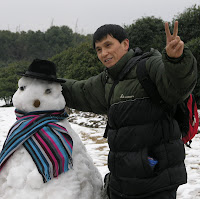
Amidst the serious problems, some have been able to relish this rare opportunity to enjoy it. You'd think this snowman in Century Park was a star. People lined up to take pictures with it in various poses.

Wednesday, January 23, 2008
Sleepy cat, clever rat
 The New Year – 2008 – marks the year of the rat in the Chinese Zodiac. The zodiac is made up of 12 animals arranged in order from the rat through to the pig. The order was decided by a race between the animals, organized thousands of years ago by the Jade Emperor of China.
The story of how the rat came in first demonstrates its cleverness. The cat and the rat, who were friends, decided to help each other in the race. They asked the ox, an early riser, to wake them on the morning of the race, but when the sun rose they could not be woken. The ox decided to carry the cat and rat on his back and was crossing a river when the rat woke up. The rat pushed the cat into the river knowing the cat was a faster runner. Then the rat jumped off the ox as it reached the riverbank and ran to victory.
The ox finished second and was followed by the tiger, rabbit, dragon, snake, horse, goat, monkey, rooster, dog and pig. The cat was too late to be included in the zodiac and, according to the Chinese, is still chasing rats to this day.
As a cat owner, I had wondered why the cat wasn't in the zodiac. This story tells us one possible reason. Cats definitely sleep a lot and don't wake up easily!
Monday, January 21, 2008
A more modern Chinese New Year
The following is a feature that will appear in the February issue of the Courier, the magazine of the Shanghai Expatriate Association. I really enjoyed speaking to the Shanghai locals about how they celebrate the new year. They recalled childhood memories of spending time with family, the excitement of waking up to new clothes, the superstitions that they followed, and the abundance of special foods during this 15 day festival.
Today, the younger generation doesn't anticipate the holiday the same way in cities. New clothes just aren't as exciting when more people can buy them year round. Not cutting your hair during the first month of the new year to prevent "cutting away" your good fortune seems silly and unnecessary. While I've been told that the rural areas still celebrate in a traditional way, it's possible some traditions could be loss in the cities in the years to come.
Here's my story...
The most significant holiday for the Chinese, the New Year or Spring Festival means getting the year off to a good start by giving thanks with family, asking the gods for good fortune, honoring ancestors, eating special foods, cleaning and decorating the home, and setting off fireworks to ward off evil spirits.
While the core of the holiday lives on, greater financial stability and modern conveniences like grocery stores and restaurants has changed how the Chinese celebrate some traditions in cities like Shanghai.
The dates for the holiday are determined by the lunar calendar rather than the Gregorian calendar, varying the holiday from late January to early February. The festival begins on the eve (This year on February 6.) of the lunar New Year Day and ends on the full moon 15 days later. The 15th day of the New Year -- the Lantern Festival -- is celebrated at night with lantern displays and children carrying lanterns in a parade.
New Year’s Eve
“You can compare Chinese New Year’s to Christmas, the most important thing is for the family to get together,” said Shanghai resident Yi Yuan, the director of foreign education department for Shanghai Foreign Services Co., Ltd.
“New Year’s Eve is the most important time. In the morning, we will shop for foods to prepare later, buy fresh flowers for our homes for luck, and decorate our homes with signs that say happiness (le) and luck (fu),” she added.
This year, Yi Yuan’s family will go out for dinner at a restaurant instead of eating at home. Traditionally, the older generation will prepare most of the food for the dinner and we wanted to give my mother-in-law a rest, she said.
After dinner, the family along with millions of others will tune in on their TVs at 8 p.m. to the Spring Festival program from Beijing. The program, started about 10 years ago, features entertainment such as dancing and singing that will go into the wee hours of New Year. The family will chat and eat snacks during this time.
Around midnight, everyone will set off some fireworks to let the bad things out and the good things in, Yi Yuan said. The fireworks could last for a couple hours throughout the city.
One of the most important New Year’s legends involves a beast called Nian, which means year in English. It was said that Nian was so strong and ferocious that his roar could shake the skies and the earth. In cold winters, he would come down to attack the villages if he couldn’t find any prey in the mountains.
Over time, people discovered that Nian was afraid of three things: the color red, flame and sound. Therefore, one winter before Nian was about to come down from the mountains, the villagers put up red colors, lit fires in front of every house and stayed up all night making different sounds. This frightened Nian enough that he never came back. The Chinese have commemorated this victory ever since.
Progress means some changes
The north and south Chinese serve some different traditional foods to celebrate the holiday. In south China, typical dishes are nian gao, sweet steamed glutinous rice pudding and zong zi (glutinous rice wrapped up in reed leaves).
In the north, steamed-wheat bread (man tou) and small meat dumplings are preferred. The tremendous amount of food prepared at this time symbolizes abundance and wealth for the household.
Shanghai resident Haiping Lian, a conservation scientist specializing in bronze at the Shanghai Museum, said the younger generation, such as her 16-year-old daughter, does not follow some of the same new year superstitions.
“One superstition that my mother told me was get up early in the first day of New Year in order to begin the year well. Now I don't request my daughter do it like I did in my childhood,” she said.
Growing up in Guangdong Province, Haiping Lian’s family would prepare all types of cakes, fish, and chicken for New Year’s Eve dinner. Now they buy some of the items at the grocery store. However, the elements remain the same for the dinner, she said.
“A fish is the most important dish for the New Year’s Eve dinner, which represents the hope that you will have enough food and money for the year. Dumplings are also served,” Haiping Lian said.
Another tradition still followed is the grandmother or grandfather giving a small red bag of money (hong bao) to the children after dinner.
“We give the hong bao to the children to wish them peace and good health during the year,” Haiping Lian said.
In the past, children would also receive new clothes during this time. Haiping Lian said she remembers the excitement of waking up with new clothes next to her.
“But now, we can buy new clothes year round. Back then, more Chinese couldn’t buy new clothes,” said Haiping Lian, who does not buy her daughter new clothes specifically for the New Year.
“New Year’s was more exciting back then. In those days, we were much poorer. New Year’s was a time of eating more meat and new clothes,” said Shanghai resident Celia Guo, in her 20s.
Guo, from Jilin Province, doesn’t plan on going back home for the holiday this year for the first time. She plans on visiting her family during another festival later on this year. During the first few days of the new year, the Chinese will visit their family and friends to wish them well.
“It’s getting more difficult to go home because more people are leaving the countryside to study and work. Train tickets are hard to come by,” said Guo, a Mandarin teacher for Ease Mandarin.
Guo will spend New Year’s Eve with her boyfriend’s family this year. Then she plans on visiting friends and bringing them small gifts, she said.
The New Year remains a special time for Guo because she will turn a year older. The Chinese are one year old when they are born and turn a year older with each New Year, she said.
To keep the spirit of New Year’s alive, Yi Yuan said she takes her 12-year-old daughter to Yu Gardens to see the sights and learn the history behind the festival. Old city - with its traditional style buildings, teahouses and gardens - will be festive and busy.
“It’s the ideal place to experience the atmosphere,” Yi Yuan said.
Today, the younger generation doesn't anticipate the holiday the same way in cities. New clothes just aren't as exciting when more people can buy them year round. Not cutting your hair during the first month of the new year to prevent "cutting away" your good fortune seems silly and unnecessary. While I've been told that the rural areas still celebrate in a traditional way, it's possible some traditions could be loss in the cities in the years to come.
Here's my story...
The most significant holiday for the Chinese, the New Year or Spring Festival means getting the year off to a good start by giving thanks with family, asking the gods for good fortune, honoring ancestors, eating special foods, cleaning and decorating the home, and setting off fireworks to ward off evil spirits.
While the core of the holiday lives on, greater financial stability and modern conveniences like grocery stores and restaurants has changed how the Chinese celebrate some traditions in cities like Shanghai.
The dates for the holiday are determined by the lunar calendar rather than the Gregorian calendar, varying the holiday from late January to early February. The festival begins on the eve (This year on February 6.) of the lunar New Year Day and ends on the full moon 15 days later. The 15th day of the New Year -- the Lantern Festival -- is celebrated at night with lantern displays and children carrying lanterns in a parade.
New Year’s Eve
“You can compare Chinese New Year’s to Christmas, the most important thing is for the family to get together,” said Shanghai resident Yi Yuan, the director of foreign education department for Shanghai Foreign Services Co., Ltd.
“New Year’s Eve is the most important time. In the morning, we will shop for foods to prepare later, buy fresh flowers for our homes for luck, and decorate our homes with signs that say happiness (le) and luck (fu),” she added.
This year, Yi Yuan’s family will go out for dinner at a restaurant instead of eating at home. Traditionally, the older generation will prepare most of the food for the dinner and we wanted to give my mother-in-law a rest, she said.
After dinner, the family along with millions of others will tune in on their TVs at 8 p.m. to the Spring Festival program from Beijing. The program, started about 10 years ago, features entertainment such as dancing and singing that will go into the wee hours of New Year. The family will chat and eat snacks during this time.
Around midnight, everyone will set off some fireworks to let the bad things out and the good things in, Yi Yuan said. The fireworks could last for a couple hours throughout the city.
One of the most important New Year’s legends involves a beast called Nian, which means year in English. It was said that Nian was so strong and ferocious that his roar could shake the skies and the earth. In cold winters, he would come down to attack the villages if he couldn’t find any prey in the mountains.
Over time, people discovered that Nian was afraid of three things: the color red, flame and sound. Therefore, one winter before Nian was about to come down from the mountains, the villagers put up red colors, lit fires in front of every house and stayed up all night making different sounds. This frightened Nian enough that he never came back. The Chinese have commemorated this victory ever since.
Progress means some changes
The north and south Chinese serve some different traditional foods to celebrate the holiday. In south China, typical dishes are nian gao, sweet steamed glutinous rice pudding and zong zi (glutinous rice wrapped up in reed leaves).
In the north, steamed-wheat bread (man tou) and small meat dumplings are preferred. The tremendous amount of food prepared at this time symbolizes abundance and wealth for the household.
Shanghai resident Haiping Lian, a conservation scientist specializing in bronze at the Shanghai Museum, said the younger generation, such as her 16-year-old daughter, does not follow some of the same new year superstitions.
“One superstition that my mother told me was get up early in the first day of New Year in order to begin the year well. Now I don't request my daughter do it like I did in my childhood,” she said.
Growing up in Guangdong Province, Haiping Lian’s family would prepare all types of cakes, fish, and chicken for New Year’s Eve dinner. Now they buy some of the items at the grocery store. However, the elements remain the same for the dinner, she said.
“A fish is the most important dish for the New Year’s Eve dinner, which represents the hope that you will have enough food and money for the year. Dumplings are also served,” Haiping Lian said.
Another tradition still followed is the grandmother or grandfather giving a small red bag of money (hong bao) to the children after dinner.
“We give the hong bao to the children to wish them peace and good health during the year,” Haiping Lian said.
In the past, children would also receive new clothes during this time. Haiping Lian said she remembers the excitement of waking up with new clothes next to her.
“But now, we can buy new clothes year round. Back then, more Chinese couldn’t buy new clothes,” said Haiping Lian, who does not buy her daughter new clothes specifically for the New Year.
“New Year’s was more exciting back then. In those days, we were much poorer. New Year’s was a time of eating more meat and new clothes,” said Shanghai resident Celia Guo, in her 20s.
Guo, from Jilin Province, doesn’t plan on going back home for the holiday this year for the first time. She plans on visiting her family during another festival later on this year. During the first few days of the new year, the Chinese will visit their family and friends to wish them well.
“It’s getting more difficult to go home because more people are leaving the countryside to study and work. Train tickets are hard to come by,” said Guo, a Mandarin teacher for Ease Mandarin.
Guo will spend New Year’s Eve with her boyfriend’s family this year. Then she plans on visiting friends and bringing them small gifts, she said.
The New Year remains a special time for Guo because she will turn a year older. The Chinese are one year old when they are born and turn a year older with each New Year, she said.
To keep the spirit of New Year’s alive, Yi Yuan said she takes her 12-year-old daughter to Yu Gardens to see the sights and learn the history behind the festival. Old city - with its traditional style buildings, teahouses and gardens - will be festive and busy.
“It’s the ideal place to experience the atmosphere,” Yi Yuan said.
Subscribe to:
Posts (Atom)
